Gaia Project
- 4.7
- Rating
- 10.00K
- Installs
- $9.99
- Price

 Analysis by App-foxy
I approached Gaia Project expecting a demanding digital board game, and that is exactly what I found: a thoughtful strategy experience that asks me to plan several turns ahead rather than chase quick rewards. It is the official digital version of the board game, developed by DIGIDICED, and its focus is firmly on deliberate decisions, resource management, and competition for space.
My first impression was that this is not a game designed to fill a few spare minutes with effortless tapping. It is better suited to the player who enjoys studying a board, comparing several possible moves, and accepting that a good plan may take time to mature. The presentation supports that serious tone, but the real attraction is the way the digital format makes a complex tabletop system easier to handle once I understand its language.
The game belongs to the board category and is suitable for Everyone, yet that age label should not be confused with simplicity. Younger players may be able to access it, but the strategic demands are substantial. I would recommend it most readily to people who already enjoy heavier board games or who are curious about learning one without needing to organize a physical table, tokens, and a rulebook every time.
You May Also Like

 Blood Strike: 2.5 Anniversary
Blood Strike’s Loadouts Turn Every Drop Into a Tactical Gamble
A close look at Blood Strike’s custom loadouts: how fast access to signature weapons reshapes its battle royale rhythm, rewards preparation, and narrows the gap between fights.

 Pandora - Music & Podcasts
Pandora’s Music Is Easy to Start, but Harder to Recover
Pandora’s strength is its low-effort path from a seed to a station. Its weak spot is how much confidence it asks you to place in connection, setup, and quiet recovery.

 8 Ball Pool
 Is Built on Rivalries, Rematches, and Routine
A close look at the rivalries, rematches, shared routines, and unanswered safety questions that turn a quick pool match into a persistent mobile community.

 Samsung Music
’s Quiet Strength Is Playing What You Already Own
Its reach comes less from spectacle than from dependable access to a personal library. That simplicity is both the app’s strongest retention engine and its ceiling.

 AccuWeather: Weather Radar
AccuWeather Review: A Quick, Clear Forecast for Everyday Decisions
For everyday plans, the best forecast is the one you can understand quickly. AccuWeather makes rain timing, radar, and local conditions easy to act on, with a few trade-offs.

 Hill Climb Racing
Why Hill Climb Racing Still Turns Crashes Into One More Run
A tiny car, a bumpy hill and one more upgrade: Hill Climb Racing keeps resurfacing because its simple chaos makes every near-miss feel personal.
More From Our News Desk
View All News


A science-fiction table that feels like a system, not a backdrop
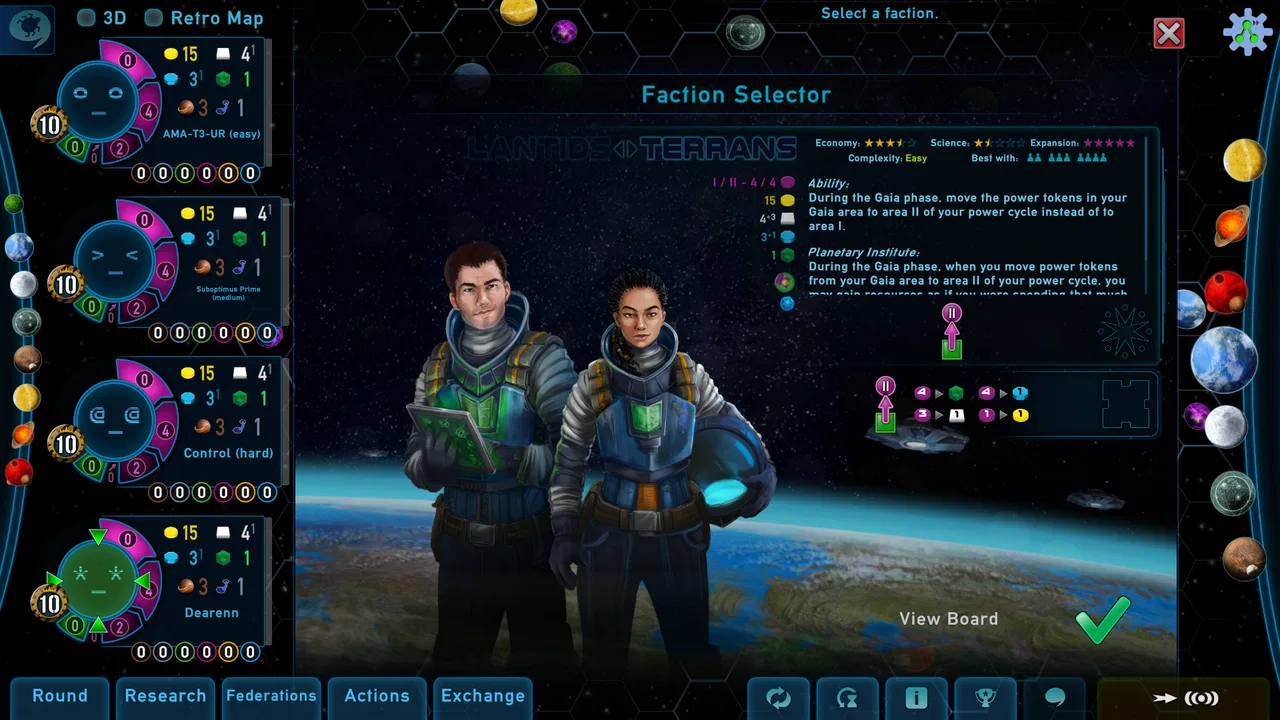
The setting works because it is tied closely to what I am doing. Gaia Project presents a spacefaring contest in which different factions seek to develop and expand, and the visual language consistently points toward technology, planets, and long-term civilization building. The art direction does not need to overwhelm the board with cinematic spectacle. Instead, it gives the strategic layout a clear identity and helps me read the game as a contest between ambitious societies.
I particularly like the way the board remains the center of attention. In many digital adaptations, decorative effects can make a familiar tabletop structure feel busy or disconnected from the rules. Here, the science-fiction presentation supports the idea that every placement and upgrade belongs to a larger technological project. The result is a mood that feels analytical and expansive at the same time.
That atmosphere also improves my understanding of the factions. Their differences are not merely cosmetic in the way I experience a round. I have to think about how a faction’s identity affects the value of locations, the timing of development, and the way I approach nearby spaces. This creates a useful tension: I am not simply building the strongest general-purpose engine, but trying to make a particular civilization’s strengths fit the map in front of me.
A practical tip emerged quickly during play: I get more from the visual design when I stop treating the board as a collection of isolated spaces. I read clusters, distances, and future routes instead. That shift matters because expansion is not only about claiming the next attractive location. It is also about preserving options for later turns and making sure my infrastructure can support the direction I have chosen.
The setting is therefore most successful when it stays connected to planning. I do not play for a story campaign or character drama. I play to feel the pressure of guiding a civilization through a limited strategic window. For someone wanting a narrative adventure, that may feel restrained. For me, it gives the science-fiction theme a practical purpose: the world looks like a place where systems, resources, and territory genuinely matter.
Reading the board before making the exciting move
One of the less obvious lessons is that the most appealing action is not always the best action. A new expansion can look satisfying, but it may leave me short of the resources needed for an upgrade that is more important to my overall position. The interface makes these choices approachable, yet it cannot remove the need to understand consequences.
I found it useful to begin each turn by checking three things in order: what I can afford now, what the round rewards, and which future connection I am trying to preserve. That small routine prevents me from spending simply because an action is available. It also makes the setting feel more coherent, because I am behaving like a planner managing a developing civilization rather than a player grabbing disconnected bonuses.
This is where the adaptation shows its value over a physical setup. A tabletop version can be wonderfully tactile, but it also demands space and constant attention to pieces and bookkeeping. The digital version gives me a cleaner way to inspect the state of play. It does not make the strategy shallow; it makes the strategic information easier to revisit.
There is still a learning curve. The board can appear calm while several important decisions are already competing for attention. New players may understand the individual actions before they understand how those actions combine into a strong round. I would not judge the game after a single confused session. The first plays are better treated as orientation, especially while learning how faction identity, terrain, technology, and timing interact.
Sound, visual rhythm, and the pace of a serious decision
The audio-visual mood is deliberately calmer than that of an action game. I do not expect constant spectacle, and that restraint suits the design. The presentation gives decisions room to breathe, which is important when I am comparing several possible routes instead of reacting to an opponent in real time.
Sound contributes more through atmosphere than through dramatic interruption. The overall effect supports concentration and reinforces the sense that I am operating inside a quiet, technological environment. I can stay focused on the board without feeling that the game is trying to hurry me toward the next move.
That pacing is one of the game’s strongest qualities, but it is also a possible weakness depending on what I want from a mobile or tablet game. If I am looking for rapid matches, constant animation, or instant feedback, the measured rhythm may feel slow. Gaia Project rewards attention rather than reflexes. Its pauses are part of the experience, not empty space waiting to be filled.
In an everyday situation, I would use it differently from a casual puzzle game. If I have a quiet evening and want something absorbing, I can settle into a session and let the board occupy my attention. If I am standing in a queue or trying to play while distracted, I am more likely to lose track of priorities and make a poor decision. The game is portable, but its mental demands are not especially lightweight.
The visual rhythm also affects how I recover from a mistake. A fast game can encourage me to move on immediately; this one makes a bad choice linger because I can see its consequences developing across the board. That can be frustrating, but it is also useful. I learn to identify when I committed too early, when I ignored a rival’s route, or when I valued a short-term gain more than a flexible position.
I would have preferred not to rely on visual familiarity alone while learning. The board communicates a great deal, but new players still need time to connect icons and spaces with their strategic meaning. My advice is to slow down and inspect the available information before committing resources. The calmer presentation makes that possible, and rushing only works against the game’s design.
Why the slow tempo can improve the experience
The unhurried pace creates a useful separation between planning and execution. I can consider a move, check how it affects my economy, and then decide whether it supports my larger objective. That makes the game feel closer to solving a layered problem than completing a sequence of obvious tasks.
It also changes how I think about competition. I am not only watching what another player has already done. I am trying to infer what spaces, technologies, or development paths they may want next. The quiet presentation leaves mental room for that kind of observation, which is one reason the atmosphere and mechanics fit together so well.
Still, players who dislike analysis paralysis should be aware of the trade-off. The more options I understand, the longer I may spend comparing them. The game does not need artificial urgency to create pressure; limited opportunities and competing plans do that naturally. I enjoy this tension, but I would not recommend the experience to someone who wants a board game to make every decision quickly.
Where the digital format earns its place
The central mechanical appeal is the relationship between expansion, resources, upgrades, and timing. I am constantly weighing what helps immediately against what improves my position later. A move that seems modest can become valuable if it opens a route, supports an upgrade, or lets me take advantage of the current round’s priorities.
This is why the game feels more substantial than a simple territory contest. Space matters, but space alone is not enough. I need to think about access, affordability, development, and the order in which I pursue them. The best turns often come from combining several modest advantages rather than waiting for one spectacular action.
The digital adaptation is especially helpful with the administrative side of that process. A physical game can make resource handling satisfying, but it can also make a complex position harder to audit. Here, I can focus more of my attention on evaluating choices instead of manually moving every component. That does not eliminate mistakes, but it reduces the friction surrounding them.
One advanced habit I recommend is to protect flexibility during the early part of a game. I used to spend too quickly on the first attractive improvement, only to discover that my later options had narrowed. Keeping enough capacity to respond to the board can be more valuable than maximizing one track immediately. This is not a universal rule, but it is a useful correction for players who naturally prefer visible progress.
Another important trade-off concerns proximity to other players. Being near a rival can create pressure, but it can also make certain developments more efficient or strategically relevant. Avoiding everyone is not automatically safe, and competing for every nearby opportunity is not automatically strong. I have had better results when I treat neighboring factions as part of the economic puzzle rather than merely as obstacles.
The game also rewards planning around the rhythm of a round. I try not to judge an action only by its permanent value. Its timing can matter just as much. A move that is average in isolation may be excellent because it secures a limited opportunity before someone else takes it, while a powerful-looking upgrade may be mistimed if it prevents me from completing a more urgent objective.
These layers explain the strong player response around the game. It holds an average rating of 4.7 from over 700 ratings, and I can understand why experienced board-game players respond positively. The appeal is not instant accessibility; it is the sense that repeated play reveals better sequencing, sharper priorities, and more reliable ways to recover from an awkward opening.
Who will enjoy it, and who should choose something else
I think Gaia Project is a strong match for players who enjoy engine building, spatial planning, asymmetric factions, and games where a small early decision can shape the rest of a session. It is also a good option for someone who wants a serious board game without needing a physical table or a group of people available at the same time.
I would be more cautious recommending it to a newcomer whose main goal is immediate fun. The age rating is Everyone, but the strategic vocabulary is not elementary. A player who prefers short, luck-driven rounds may find the concentration required excessive. Someone looking for a social party game should also choose a different category of experience, because this is primarily about evaluating a complex position.
Compared with lighter digital board games, this one offers more depth but demands more study. Compared with a physical board-game session, it is more convenient and less dependent on setup, but it gives up some of the tactile pleasure of handling pieces around a shared table. Compared with an abstract strategy title, its faction and science-fiction identity provide more thematic direction, although the story remains secondary to the systems.
The price is $9.99, which makes the decision easier for a committed strategy player than for someone browsing casually. I would consider it worthwhile if I already know I enjoy substantial board games and expect to return to the same system repeatedly. I would hesitate if I only want a quick one-off diversion, because the value comes from learning the structure and gradually making better decisions.
Device compatibility is also straightforward for a relatively broad range of users: the game requires Android 8.0 or later. Its current version is 53, and it has passed the ten-thousand-install mark. Those details do not tell me whether every individual device will feel equally comfortable, so I would still pay attention to screen size and control comfort, especially because the board contains a lot of information that benefits from clear viewing.
The game was released on November 17, 2021, and that history helps explain its established feel. It is not presented as a brand-new experiment in digital board gaming. It feels like a mature adaptation built around a demanding tabletop design, with the main challenge being learning how to read its systems rather than discovering whether the concept works at all.
How the atmosphere supports repeated strategic play
What stays with me is the consistency between the mood and the mechanics. The quiet science-fiction setting, restrained presentation, and deliberate tempo all reinforce the same idea: I am managing a civilization through a sequence of difficult choices. Nothing feels completely separate from that central fantasy.
That coherence matters because heavy strategy games can become dry when their theme is only decoration. Here, the setting gives my decisions a recognizable shape. Expansion feels like development, upgrades feel like technological progress, and the board feels like a contested map rather than a neutral grid. I still care about the numbers and timing, but the world gives those calculations a reason to matter.
My most successful sessions have not been the ones where I tried to execute a perfect plan from the beginning. They have been the ones where I chose a broad direction, watched the board change, and adjusted without abandoning my faction’s strengths. That is a valuable lesson for new players: aim for a flexible strategy, not a rigid script.
I also recommend learning to distinguish a bad position from a bad-looking position. Falling behind in one visible area does not necessarily mean the game is lost if another route remains open. Conversely, having an attractive cluster on the board does not guarantee success if the economy behind it is weak. The digital interface makes the current state easier to inspect, but judgment still comes from understanding relationships rather than counting isolated achievements.
There are moments when the adaptation feels less welcoming than it could. The number of interacting systems can make the first sessions mentally tiring, and the calm rhythm may amplify that feeling because every decision appears to deserve serious attention. I would not call this a flaw in the core design, but it is a real barrier. Players should expect to learn by playing, reviewing mistakes, and gradually recognizing patterns.
For that reason, I see it as a game to keep installed rather than one to finish and forget. The official digital format is most valuable when I return to it with a better understanding of priorities. Each session gives me a clearer sense of how early positioning, resource conservation, and timing affect the final result.
My recommendation after living with the design
I recommend Gaia Project to anyone who wants a serious, atmospheric board game that respects their attention. Its science-fiction art direction is not merely decorative, its sound and pacing create a focused mood, and its mechanics give that mood real substance. The experience asks me to think carefully, but it rewards that effort with decisions that feel connected and consequential.
I would skip it if I wanted a fast, casual game with obvious moves, strong narrative scenes, or constant action. I would also avoid buying it on impulse unless I already knew that complex strategy games appeal to me. The price is reasonable for the depth on offer, but depth only becomes value when I am willing to learn the systems and play more than once.
For the right player, the strongest feature is not a single faction, effect, or visual flourish. It is the complete relationship between the board, the setting, and the pace. I feel as though I am building a plan inside a living strategic landscape, then watching that plan succeed or unravel because of choices I made several turns earlier.
That makes the game a convincing digital home for its board-game design. It preserves the sense of a demanding tabletop contest while removing much of the physical administration. My final view is simple: this is a patient strategy game for thoughtful evenings, not a disposable time-killer. If that description sounds appealing, DIGIDICED’s adaptation deserves a place on your shortlist.
FAQs for Gaia Project
01What is Gaia Project?
Gaia Project is a digital adaptation of the popular Terra Mystica-style strategy board game. Players lead an advanced faction competing to expand across a changing galaxy, develop technologies, build structures, and manage resources efficiently. The game focuses on long-term planning rather than quick reactions, making it especially appealing to fans of complex euro-style strategy games.
02How does the gameplay work in Gaia Project?
Each round, you expand your territory, transform planets so your faction can inhabit them, construct buildings, upgrade technologies, and collect resources. Every decision affects future turns, because power, knowledge, ore, credits, and population are limited. The objective is to score more victory points than your opponents by combining expansion, technology development, federation building, and efficient resource management.
03Is Gaia Project suitable for beginners?
Gaia Project is designed primarily for experienced strategy players and can feel complicated at first. The game includes many systems, including faction abilities, planetary transformations, technology tracks, power management, and federation requirements. New players should expect a learning period and may benefit from starting with a simpler faction, reading the rules carefully, and playing a few practice games before competing seriously.
04Can I play Gaia Project offline or against other players?
Gaia Project offers a strategic experience that can be enjoyed through solo play and multiplayer matches, depending on the version and platform features available. Solo games are useful for learning the rules and testing different factions, while multiplayer provides the most competitive experience. Before downloading, check the current store description because online functions, supported modes, and account requirements may vary between Android and iOS.
05Is Gaia Project free to download and does it include in-app purchases?
The availability and pricing of Gaia Project can differ by platform, region, and promotional period. In many cases, the game is offered as a premium purchase rather than a completely free title, but users should verify the current Google Play or App Store listing before installing. Also check whether expansions, optional content, or multiplayer-related features require separate purchases or additional payments.
Pros
- Deep strategic gameplay with many viable paths to victory.
- Excellent replay value through variable factions and board setup.
- Supports solo play as well as competitive multiplayer sessions.
- Clear interface makes complex resource management easier to follow.
- Minimal luck keeps outcomes focused on planning and decision-making.
Cons
- Steep learning curve can overwhelm players unfamiliar with strategy games.
- Matches may take a long time
- especially with several players.
- Limited appeal for users seeking quick or casual gameplay.
- Small interface elements may feel cramped on some phone screens.
- Understanding faction abilities requires careful reading and practice.

Gaia Project
Gallery